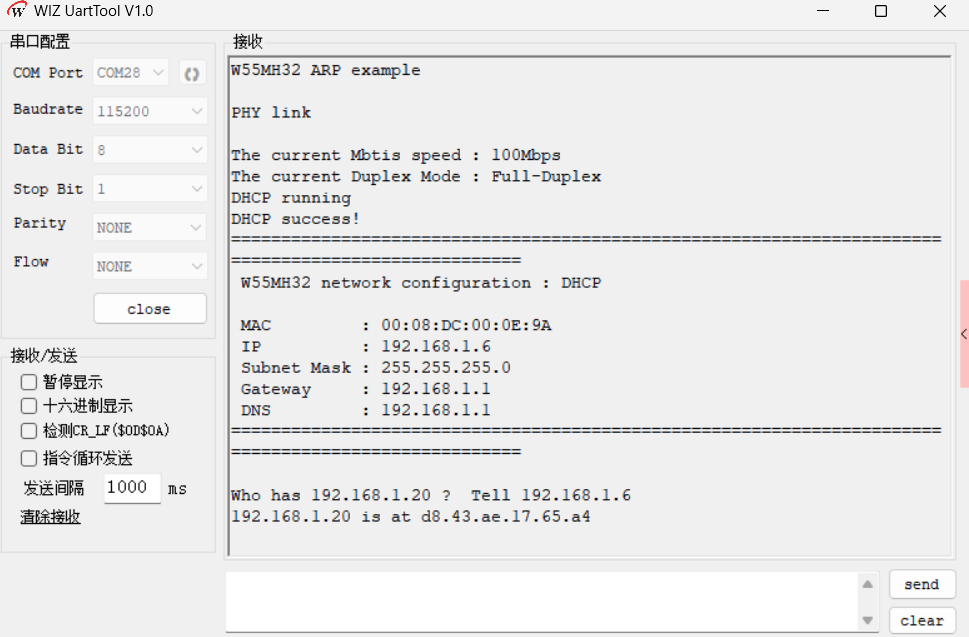
void arp_request(uint8_t sn, uint16_t port, uint8_t *dest_ip)
{
  uint16_t i;
  uint8_t  broadcast_addr[4] = {0xff, 0xff, 0xff, 0xff};

  for (i = 0; i < 6; i++)
  {
      pARPMSG.dst_mac[i] = 0xff; // Broadcast address in an Ethernet frame
      pARPMSG.tgt_mac[i] = 0x00;
      if (i < 4)
      {
          pARPMSG.tgt_ip[i] = dest_ip[i];
      }
  }
  getSHAR(pARPMSG.src_mac);              // Fill in the source MAC address of the link layer
  getSHAR(pARPMSG.sender_mac);           // Fill in the MAC address of the sender in ARP
  getSIPR(pARPMSG.sender_ip);            // Enter the IP address of the sender in ARP
  pARPMSG.msg_type = htons(ARP_TYPE);    // ARP type
  pARPMSG.hw_type  = htons(ETHER_TYPE);  // Ethernet type
  pARPMSG.pro_type = htons(PRO_TYPE);    // IP
  pARPMSG.hw_size  = HW_SIZE;            // 6
  pARPMSG.pro_size = PRO_SIZE;           // 4
  pARPMSG.opcode   = htons(ARP_REQUEST); // request: 0x0001;  reply: 0x0002

  if (sendto(sn, (uint8_t *)&pARPMSG, sizeof(pARPMSG), broadcast_addr, port) != sizeof(pARPMSG))
  {
      printf("Fail to send arp request packet.\r\n");
  }
  else
  {
      if (pARPMSG.opcode == htons(ARP_REQUEST))
      {
          printf("Who has %d.%d.%d.%d ?  Tell %d.%d.%d.%d\r\n",
                  pARPMSG.tgt_ip[0], pARPMSG.tgt_ip[1], pARPMSG.tgt_ip[2], pARPMSG.tgt_ip[3],
                  pARPMSG.sender_ip[0], pARPMSG.sender_ip[1], pARPMSG.sender_ip[2], pARPMSG.sender_ip[3]);
      }
      else
      {
          printf("Opcode has wrong value. check opcode!\r\n");
      }
  }
}
报文组包关键:目的 MAC 设为广播地址 FF:FF:FF:FF:FF:FF,目标 MAC 设为 0x00(待解析),Opcode 设为 ARP_REQUEST(0x0001)。htons() 用于字节序转换。通过 sendto() 以广播方式发送。
步骤4:arp_reply() 解析 ARP 响应
文件:USER/arp/arp.c。接收 ARP 报文并进行校验:如果报文为回复报文(Opcode=2)且回复的 IP 地址与请求的 IP 匹配,则将 arp_succ_flag 置 1,表示 ARP 请求成功。
void arp_reply(uint8_t sn, uint8_t *buff, uint16_t rlen)
{
    uint8_t  destip[4];
    uint16_t destport;
    uint8_t  ret_arp_reply[128];
    uint8_t  i;

    recvfrom(sn, (uint8_t *)buff, rlen, destip, &destport);

    if (buff[12] == ARP_TYPE_HI && buff[13] == ARP_TYPE_LO)
    {
        aAPRMSG = (ARPMSG *)buff;
        if ((aAPRMSG->opcode) == htons(ARP_REPLY))
        {
            for (i = 0; i < 4; i++)
            {
                if (aAPRMSG->tgt_ip[i] != pARPMSG.tgt_ip[i])
                {
                    break;
                }
                arp_succ_flag = 1;
            }
            memset(ret_arp_reply, 0x00, 128);
            sprintf((char *)ret_arp_reply, "%d.%d.%d.%d is at %.2x.%.2x.%.2x.%.2x.%.2x.%.2x\r\n",
                    aAPRMSG->sender_ip[0], aAPRMSG->sender_ip[1], aAPRMSG->sender_ip[2], aAPRMSG->sender_ip[3],
                    aAPRMSG->sender_mac[0], aAPRMSG->sender_mac[1], aAPRMSG->sender_mac[2], aAPRMSG->sender_mac[3],
                    aAPRMSG->sender_mac[4], aAPRMSG->sender_mac[5]);

            printf("%d.%d.%d.%d is at %.2x.%.2x.%.2x.%.2x.%.2x.%.2x\r\n",
                    aAPRMSG->sender_ip[0], aAPRMSG->sender_ip[1], aAPRMSG->sender_ip[2], aAPRMSG->sender_ip[3],
                    aAPRMSG->sender_mac[0], aAPRMSG->sender_mac[1], aAPRMSG->sender_mac[2], aAPRMSG->sender_mac[3],
                    aAPRMSG->sender_mac[4], aAPRMSG->sender_mac[5]);
        }
        else if ((aAPRMSG->opcode) == htons(ARP_REQUEST))
        {
            printf("Who has %d.%d.%d.%d ? Tell %.2x.%.2x.%.2x.%.2x.%.2x.%.2x\r\n",
                    aAPRMSG->tgt_ip[0], aAPRMSG->tgt_ip[1], aAPRMSG->tgt_ip[2], aAPRMSG->tgt_ip[3],
                    aAPRMSG->sender_mac[0], aAPRMSG->sender_mac[1], aAPRMSG->sender_mac[2], aAPRMSG->sender_mac[3],
                    aAPRMSG->sender_mac[4], aAPRMSG->sender_mac[5]);
        }
    }
    else
    {
        // printf("This message is not ARP reply: opcode is not 0x02!\r\n");
    }
}